Thursday, June 14, 2012

Solar Hot Water and Space Heating System With Integrated Boiler

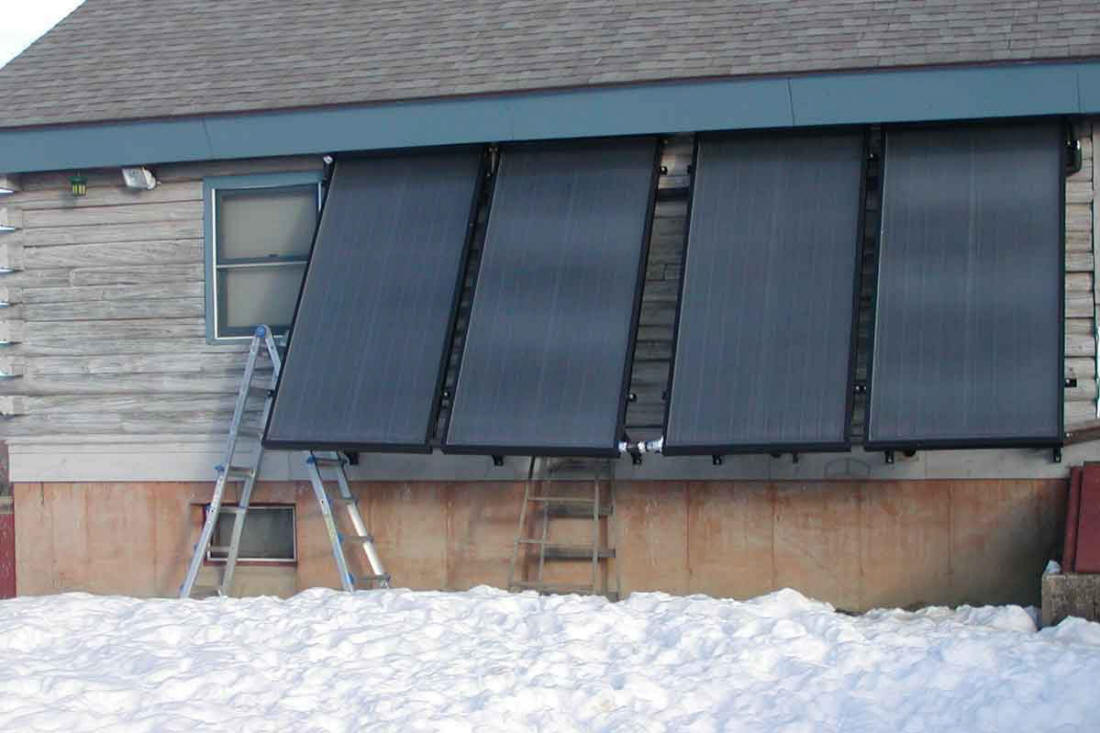
This is Norm's very nicely done solar space and water heating system.

The system uses a large, unpressurized tank that serves as both the solar heat storage tank and the drain back tank for the collectors.  The solar heat is used both to preheat domestic water and also for space heating, which is integrated with a propane fired boiler.

The solar storage tank with the copper coil heat exchangers.

Heat is extracted from the tank using one heat exchanger for space heating and a 2nd for domestic water heating.  Both heat exchangers are made from two coils of copper pipe with parallel flow and are very nicely done.  Norm provides good detail on making these heat exchangers.

The system uses four Sun Earth flat plate collectors.
The four 4 by 10 ft Sun Earth Collectors.
In Norm's system the boiler is integrated with the solar system such that the boiler only provides heat when the solar collectors cannot.
Boiler is at upper left -- solar components are mounted on the tank wall.

Heat distribution is to PEX runs in concrete and to the radiant floor done with Warm Board shown just below.
Warm Board hydronic radiant flooring distributes solar heat.

All the details on Norm's olar Hot Water and Space Heating System With Integrated Boiler...

Gary


Saturday, June 9, 2012

Energy Fair Season!

Its the Energy Fair season!

Energy Fairs provide a great way to learn about renewable energy and sustainable practices.  They typically include workshops, seminars, demonstrations and exhibitors -- everything you need to get started on that next project.

From the point of view of Do-It-Yourselfers, the MREA Energy Fair in Wisconsin is probably the best of the best.  June 15-17, Custer, WI.

MREA

MREA Workshops
The MREA workshops alone are amazing in their scope and the level of expertise of the workshop hosts...
More than 200 workshops...

Or, find an Energy Fair near you.

A list of the Energy Fairs I know about in the US is here:...
Its hard to keep this list up to date and websites, dates, ... change each year -- so, if you find an Energy Fair on the list, but the link is broken, just Google for it.
There are also MANY fairs that are not on the list, so check around and see what you can find in your area.

If you are putting on an Energy Fair, let me know the date and place and I'll add it to the list -- contact Gary...


Gary


Tuesday, May 29, 2012

Greg's Near Zero Energy Solar Upgrade of a New Mexico Home


Greg used a well thought out combination of insulation upgrades and a solar space and water heating system to cut his space and water heating energy use of his all electric home to nearly zero.  
Greg's NM near net zero remodel -- collectors to left.
The house has been foamed and then plastered over the entire exterior.
This project shows that you can live within the limitations of an existing home and still make dramatic reductions in energy use within a reasonable budget.

Greg did most of the work himself, and goes through the details of planning and installing the upgrades.

The 2000 gallon heat storage tank stores heat for a couple days of cloudy weather.

Greg used a balanced approach consisting upgrades to the home's thermal envelope to reduce heat loss, and then the addition of a solar heating system sized to meet the remaining heat loss.

The thermal envelope upgrades consisted primarily of adding external foamed in place insulation, adding attic insulation, and  thermal window treatments.  These upgrades reduced the home heat loss to the point where a reasonable size solar heating system could heat the house.

The solar heating system consists of four large ground mounted solar water heating collectors.  The solar collectors provide heat to to a large and very well insulated fiberglass tank that is sized to store heat over cloudy periods.  Both the collectors and tank have been carefully added in such a way as to preserve the good looks of the home.

A hydronic heat distribution system was added to distribute the stored solar heat to the home as required.  The hydronic systems replaces the electric baseboard units that came with the all electric house.
Four large solar water heating collectors provide space and water heating.

With the insulation and solar heating upgrades, the home is now totally self sufficient on space heating and water heating energy use.

Greg plans to add a PV array on the roof to meet the remaining small electrical demand.  When the PV array is completed, the house will be a net zero energy home.  Net zero energy use is very difficult to achieve even for new construction homes, so it says a lot about Greg's design that he was able to achieve this zero energy use on a remodel and within a reasonable budget.

Central control.


Thanks very much to Greg for taking the time to document and send in the project!


Gary

Saturday, May 26, 2012

Solargraphy, Windmill Water Pumpers, and Solar Air Floor Heat

Just catching up on  a few new entries at Build-It-Solar.


New Solargraphy pictures from Kevin
Kevin's Solargraphy "cans" have been taking pictures for the last few months with some really nice results.

A 4 month exposure Solargraphy picture

All the details on how to do your own Solargraphy pictures...

Some Ways of Distributing Solar Heated Air to Floors
Most solar air heating collectors just distribute the solar heated air directly to the living space, but here are a couple ways to do radiant floor heating with solar heated air....

Scheme for heating a slab floor with solar heated air.

Updates to the Windmill Water Pumping Section
Added a link to the very nice Ainsworth site on water pumping windmills as well as a link to the Vintage Windmills News -- a good newsletter on restoring wind pumpers.
From Vintage Windmills News

Also added a link for the  Airlift Windmills -- on these windmills, the wind turbine drives a compressor which provides compressed air for a bubble pump.

If you have not taken the time to look at some of the pictures in this section of the beautiful old wind pumpers, you are in for a treat!

The windmill water pumping section...


Gary

Monday, May 14, 2012

Using PV Panels for Shading Structures

I've added a small new section on using PV modules that both generate electricity and provide shading.

The main entry is an article sent in by Amy and Dennis Heidner which describes in good detail how they went about designing and building a deck canopy that provides shading for the deck and for the living space in the house behind the deck.
Shading structure using PV panels.

One of their concerns was that it would be too dark under shading surface made with PV panels.  They describe how they were able to take light meter readings behind a variety of PV modules and find a module that had enough open area to provide the lighting the wanted.  They also included small glazed areas above and below the PV modules that also let in light.  In the end, they got just the light level they were looking for.

Incorporating small glazed areas to get the right light level below the canopy.
The new PV module shading section also includes the use of bifacial PV modules for shading.  Bifacial PV modules accept light from either side and do not have the opaque layer behind the silicon cells that regular PV panels have -- this means that they are semi-transparent and this works out well for some shading situations.

There are also links to a variety of projects that use PV modules for shading just to show some of the unusual and creative ways people have come cup with.


All the details on PV modules for shading structures...


A shade umbrella using PV panels

Gary


Saturday, May 12, 2012

How Large a Solar Collector Do You Need to Heat Your Hot Tub?


This is a pretty good method to determine how large a solar collector is needed to heat your hot tub. 

The size of the collector needed to heat a hot tub depends on a lot of things: volume of the tub, how well its insulated, how good the cover is, what your climate is like, how hot you keep it, ...   Its not easy to take all that into account to get a good idea what size collector you need.  But, I ran across the method detailed below in "More Other Homes and Garbage" that uses the temperature drop of the hot tub over 24 hours to determine the daily heat loss for your hot tub in your climate and for the way you use it -- it seems like a good approach to me.


By the way  "More Other Homes and Garbage" is a terrific book written the 80's, but full of good ideas, good analysis, and written in a style that won't put you asleep -- and, its only $8 used!  Better get one before they all disappear!


Given that hot tubs are the biggest energy users in most homes that have them, its not a bad idea to do the test on your hot tub to see how the heat loss looks, and even if you can't do a solar heater, things like more insulation and a good cover can make a lot of difference.


Gary

Saturday, May 5, 2012

Night Air Thermal Mass Cooling Using Water Barrels


This is a scheme that I am experimenting with to cool my shop.  It basically blows cool night time air over a collection of 50 gallon barrels filled with water to store "coolth" in the water. 

The idea is to cool the barrels down during the night hours, and then use the stored "coolth" in the barrels for space cooling during the daytime.  This requires a climate in which the night temperatures drop down to low levels even though the daytime highs are uncomfortably warm -- this is true for much of the western US.

While I am using the scheme in my shop, it could be used to cool any interior space.  Note that we use a variation on this cooling scheme to cool our house ...  The basic question is: does it make sense to use a fan forced flow of cool night air over thermal mass to store "coolth" for later use in daytime cooling?

Logger plot of water barrel storage and shop temperatures
with fan forced outside air flow over barrels at night.


This is definitely a work in progress, and I'm looking for any ideas people might have to make it work better.  I think that it has the promise to deliver good cooling performance for near negligible energy consumption (SEER 150 ish).   


This scheme only works for climates in which the night time temperature drop to relatively low levels even when the day temperatures are hot -- typical of a lot of the US west.


All the details and questions on night air cooling of water barrel thermal mass...

Water barrels for storing night time "coolth"

Rough prototype cooling tunnel to direct fan forced night time
airflow over the water barrels for good heat transfer.
In this particular scheme, the same water barrels are used to both store heat in the winter and store "coolth" in the summer!

Gary

Tuesday, April 24, 2012

Don's Solar Scooter -- 8 years and still going strong

Don just sent the 2012 update for his solar electric scooter -- see below.

For those who missed this nice and simple conversion of EVT 4000E electric scooter into a solar powered electric scooter, the full plans and how-to are here...

Don's conversion is somewhat unique in that he added folding PV panels to the scooter so that it can charge while he is at work or in town.

Don and the solar scooter

This is the 2012 update from Don:

The scooter still flying...returned to Earth Day 2012 At University of Michigan, Flint.    Scooter a hit again.  Kind of humbling that the interest is still strong.  Will be on the local TV 25 news in May.  They are doing an ECO Fuel Story about people doing things to avoid purchasing gasoline. 

The scooter survived another winter outside.  I took off the  rear view mirrors and covered Scooter with plastic except for the solar panels this year.

14 miles into Flint for Earth Day and 14 back.  No problems.  The evening before I replaced one of the top cross locking bars that was bent the night before Earth Day last year when Scooter tipped over in the wind when I was out of town and a storm hit.   I had hand straightened it, but decided to replace it this year.  Replacement took less time than going to town to purchase a new piece of stock. 

For others with electric scooters, check you tire pressure.  On the first after winter  trip to town a couple of weeks ago, the light kept going to the second or third level down from full charge indicating a higher amp drain.  This despite a full battery.   Apparently only having 10 lbs of pressure in tires made for 40 lbs,  does effect performance and subsequently range.

That is about all for this years update.

Don


See the link above to see the details on converting the scooter to solar and 8 years worth of riding experience with it.

Showing the solar panels folded out for charging.
Thanks again to Don for sharing the details on doing the conversion and the updates on how its working out.

Gary


Wednesday, April 18, 2012

Sandbed Heat Storage for Solar Homes -- A Minnesota Example

An example of a home in northern MN that uses an insulated  sand bed under the home to store solar heat for  space heating the home.


The house is 600 sf and has a 2 ft deep sandbed under the concrete floor slab.  The home is well insulated with strawbale walls and R60 ceilings.

About 160 sf of conventional solar thermal collectors add heat to the sandbed on sunny days.

The heat from the sandbed is conducted directly into the living space through the floor slab.

After 3 years in the house, the owners are very happy with the house both from an energy saving and comfort point of view.

All the details on this Minnesota sandbed storage solar home...

Thanks very much to Maureen for providing the details.

-----------------------------------------------------------------------------------------------------------

Also,  revamped the whole section on sandbed storage homes and related ideas....

Gary

Saturday, March 31, 2012

Doug's Solar Projects

For those of you who don't know about Doug Kalmer, he is a renewable energy expert who lives in Tennessee, and who really walks the talk on the renewable energy and sustainable living fronts.
His projects use simple, elegant, well thought out designs that are durable and cost effective.  Most of the projects can be built by any reasonably skilled DIYer.

The projects cover an amazing range of renewable energy and sustainable living areas.


Note that Doug's house is going to be on the solar tour this year, so if you live in the area, go have a look.

Here is a list of Doug's projects on Build-It-Solar -- follow the links for full details:

Doug's 1985 solar passive home in Tennessee has been largely heating itself through several decades.
It uses a combination of passive solar gain for heat and earth berming to reduce heat loss.
Backup heat is provided by the masonry heater described below.

This is Doug's latest project.  It is a 4.6 KW grid-tied PV system that uses Enphase micro inverters on each PV module to make utility compatible solar electricity.  The mount system is all Doug designed and built and is simple, strong, durable and very cost effective.


Doug designed and built this efficient and very beautiful masonry stove to provide backup space heating for the passive solar home.

The masonry stove is designed to burn hot, fast, and clean while capturing the heat in the stone and radiating heat for hours after the fire goes out.


The attached solar greenhouse was built for and amazing $300 using sliding glass door panels.

The solar greenhouse allows plants to be started in January and February and then moved out.  The greenhouse also provides some heat to the house.


These thermal shades provide R values equivalent to the best of the commercial thermal shades and also look very nice -- all for about $15 a shade!

They use the Reflectix as the insulating material.

In my climate, this thermal shade can pay for itself in a single season over a double glazed window.


Doug has two solar water heating systems.  
Both are simple and cost effective designs that work well.

The closed loop system heats water for his house.
The thermosyphon system heats water for the shop/studio.


Doug used slipform walls for his home, and this project explains how to build slipform walls.

This is a technique that owner builders can use to provide a wall that is very durable, cost effective to build, and looks beautiful.


This is an interesting project that uses a salvaged AC unit and "Corny Kegs" to make an efficient heat pump for cooling the beer keg.

The heat pump takes heat from the beer and uses it to heat domestic water.


I want to thank Doug again for doing these projects and for taking the time to document them and make them available  -- Thanks!

Gary


/* Start Analytics ---------------- */ /* End Analytics ---------------- */