Saturday, July 7, 2012

DIY Solar Water Heating for 7 Unit Apartment

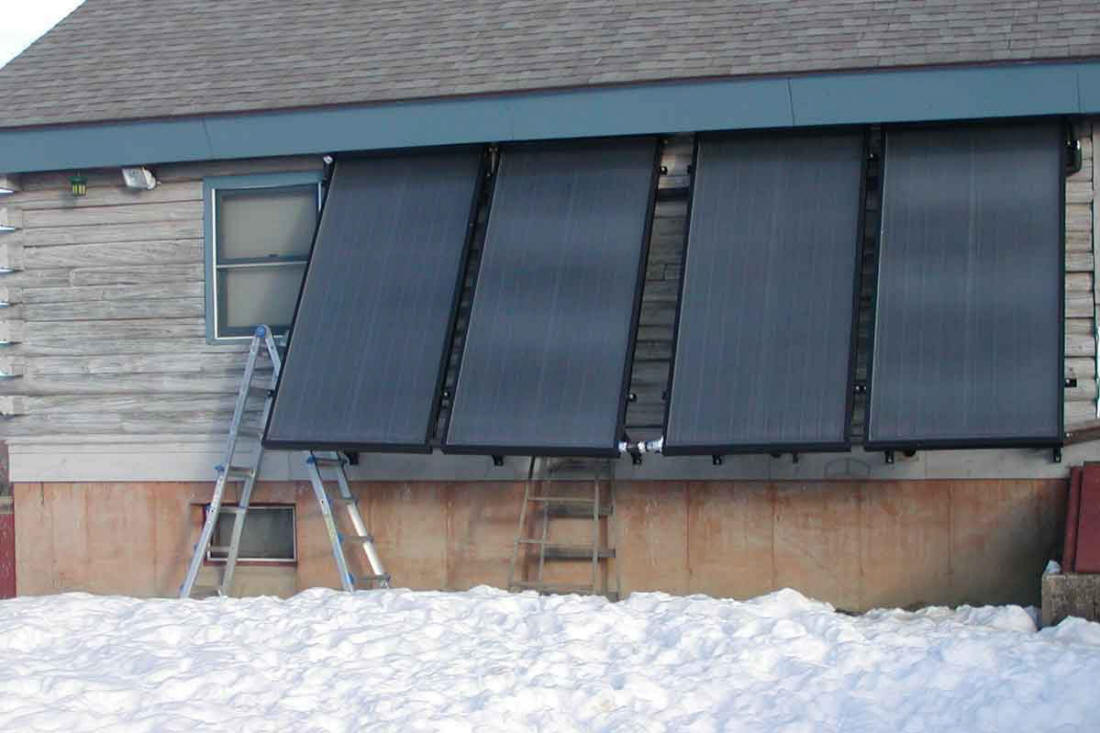
This is Micah's DIY solar water heating system for a seven unit apartment building in Iowa.

Collectors solar preheat water for apartment building.
The system is a drain back system similar to the $1K systems, but larger to accommodate the 7 units and with a few design changes to match the situation.

The solar heated water storage tank located inside the building's utility room right behind the collectors, which makes for nice direct plumbing.

The collectors.
The collectors are glazed with twinwall.  Note the very nice job of trimming and flashing the collector glazing.

The tank is a non-pressurized combination drain back and solar heat storage tank that is constructed with OSB and lined with EPDM rubber membrane.

Drain back and solar heat storage tank.  


Nice simple plumbing using PEX and SharkBite fittings.  These are the valves that allow the solar water preheat to be bypassed if desired.

Micah's day job is in Nepal, and he has some interesting comments on solar in Nepal.

Solar water heaters everywhere in Nepal

Download all the details on Micah's 7 unit apartment solar water heater...


Gary


Tuesday, July 3, 2012

Cooling Without Power

I know there are a few million people out there now in hot weather and without power due to the storm.

Here are a few ideas on cooling without electricity that are quick to implement and might be helpful during the hot weather power outage.

If you know people who are without power in hot weather, please pass on these ideas to them.

- Stop window solar heat gains during the day.  Windows that face south, east or west are major sources of solar heat gain that tend to cook the house.  Its critical to stop this heat gain from heating the house.

The best place to stop the solar heat gains is outside the windows with external shades -- this keeps the heat totally out of the house.  If you are working from the inside of the house, closing blinds (especially if they are reflective) is helpful.   Putting aluminium foil against the window would be much more effective in that it efficiently reflects both the visible and IR in the sunlight back out the window.

An easy and quick to install set of external shades like these can make a huge difference...

More on window shading here...


- Water the roof.  Putting a sprinkler on the roof to wet it down intermittently will cool the roof by evaporation, and therefore cool the attic.  The cooler attic will reduce the heat gain to the house.  Here is an example roof cooling system...

There are more examples in this section of the Cooling page on Build-It-Solar...

Example of a fancy roof cooler, but a sprinkler or two will do.

- Shade the house.  This may not be that easy to do on short notice, but anything that shades the exterior of the house will reduce heat gain.  Maybe a jury rigged set of Shade Sails?...

- Using cool basement air.  Some people have reported that circulating cool basement air to the living area can be quite helpful.  This is a simple example of Fran's system...  While this system uses a small fan, if you open a window in the basement and a window as high as possible in the house, the stack effect will tend to circulate the air even without a fan.  Or, I guess, you cold just move down to the basement?

- Ventilation.  In these days of Air Conditioning and powered everything, people tend to forget how effective night time open window ventilation can be.  Opening windows on opposite sides of the house in the direction of the wind is helpful.  In multi-story homes, opening windows low and high makes use of the stack or chimney effect to circulate more air.
If it cools off enough at night, using as much might ventilation as possible to cool the thermal mass of the house will make it more comfortable on  the following day...

If you can rig up a fan that is solar powered or car battery powered, this can help a lot with the ventilation.  Solar powered attic ventilation fans are available at a lot of hardware stores...

- Evaporative Cooling.  One simple form of evaporative cooling that has been reported to work pretty well if you have a concrete patio and a window above the patio where air is flowing into the house.  You wet the patio area down with a hose, and try to keep it wet.  The evaporation of the water cools the air before it enters the window.  The evaporation also adds humidity, so this will not be as effective if the humidity is already high.
Conventional evaporative (swamp) coolers require some power, but much less that conventional AC units for the same output, but, again, are less effective in high humidity areas...
Some evaporative coolers are solar powered -- an example...

Edit July8: Note the DIY solar powered evaporative coolers here...  This is something one might be able to make on short notice for cooling during an extended power outage.  It could be run directly off solar or a solar charged car battery.


Mist Cooling.  Mist cooling can be very effective for even fairly large outdoor areas.   Here is one DIY outdoor mist cooler...   Dripworks sells an inexpensive mist cooling kit...

- Cooling just your immediate area.  This section gives two simple schemes in which only your immediate sleeping area is cooled...  Very little power required.
If you can get ice, the water bed scheme might work with ice cooling?  Insulate around the outside to keep the coolth in the waterbed.

- Reflective roofs.  This is perhaps a bit extreme, but you could change your roof color to white...

There are dozens more cooling ideas on the Build-It-Solar Passive Cooling page -- many of these require no or minimal electricity to implement ...

If you know of any additional good cooling ideas for emergency power outage situations, please add them in the comments, or email me -- Gary...


If you try any of these methods, I'd like to hear how they worked out for you.

Gary

Monday, June 18, 2012

A New DIY Solar Water Heater That Goes Together Like LEGO's

I'm taking a cut at a new solar water heating system that is an easier and quicker DIY project than our current $1K system.

While our current $1K solar water heating system has been popular and lots of people have built it with good success, it does require the building both the collectors and the solar storage tank yourself, and that takes a bit of time.

The aim of the new system is to make the job of doing your own solar water heating system quicker and easier by using all off the shelf components that just need to be mounted and hooked up together.

A prototype system is in the works using these components:
  • Collectors are 80 sq ft of plastic matt style pool heating collectors 
  • The tank is the 175 gallon Softank 
  • The controller is a standard differential controller from sun-pump
  • The pump is a Grundfos HVAC circulation pump
The prototype is very much a work in progress, and I'm looking for ideas and comments.  Please look over the design and build, and if you have any thoughts on the system please leave comments on that page.

The system design is very much like the existing $1K system in that it is a drain back system that uses a large, non-pressurized tank for both the drain back tank and for heat storage.  It also uses the one pass large coil of pipe heat exchanger to preheat cold water before it gets to your hot water heater.

Overview of the Components
Collectors:

The 80 sf of pool heating collector in place.
The collectors are lightweight and easy to handle and install.  You can put 40 sf of collector under one arm and easily climb a ladder.  The three season performance of these collectors is good in a solar water heating application, and there are some ideas on how to improve the not so good winter performance -- maybe you have more ideas?

A nice side benefit of using these collectors is that they are SRCC OG100 certified, and therefore the whole system qualifies for the federal tax credit, and maybe state rebates depending on where you live.


The prototype collectors are Fafco SunGrabbers bought on ebay.

Solar Storage Tank:
The tank is the Softank kit offered by American Solartechnics.  The kit goes together easily and the tank holds about 180 gallons of solar heated water.  
The Softank with 175 gallons of water.
The top of the tank looks like a mess because I've not finished the lid
and not trimmed things back and tucked things in.
The controller and pump are visible at the left.
The insulation bulges on the pipes are covering temperature logging sensors.
Controller:
The controller is an off the shelf differential controller from sun-pump that has all the advanced features at a not so advanced price.
The controller -- the wiring showing here is
most of the wiring for the whole system.
Pump:
The pump is a Grundfos 15-58 three speed HVAC circulation pump.  These pumps are relatively efficient and very rugged with a reasonable price.  
The Grundfos pump -- this is the rest of the wiring.


Heat Exchanger:
The heat exchanger is a large coil of PEX pipe that is immersed in the tank.  Cold water from the street takes one pass through this coil to be preheated on its way to your hot water tank.  It is the same one that is used in the $1K system and is explained in detail there.


Plumbing and Electrical:
The system is plumbed together with easy to use CPVC pipe.  This is the easiest system for people new to plumbing.  You cut it with a scissors like device and the joints are just glued together.  Goofs are easy to fix.  There is a  little bit of electrical wiring is that is easy and safe to do.


The target cost for the system is around $1300 before rebates.  Depending on your rebate situation, payback may inside one year.


All the details on the Off-The-Shelf DIY Solar Water Heating System...

The "going together like LEGO's" title is no doubt an exaggeration, but the system is designed from the bottom up to be easy to put together.


Let me know what you think.


Gary


Thursday, June 14, 2012

Solar Hot Water and Space Heating System With Integrated Boiler

This is Norm's very nicely done solar space and water heating system.

The system uses a large, unpressurized tank that serves as both the solar heat storage tank and the drain back tank for the collectors.  The solar heat is used both to preheat domestic water and also for space heating, which is integrated with a propane fired boiler.

The solar storage tank with the copper coil heat exchangers.

Heat is extracted from the tank using one heat exchanger for space heating and a 2nd for domestic water heating.  Both heat exchangers are made from two coils of copper pipe with parallel flow and are very nicely done.  Norm provides good detail on making these heat exchangers.

The system uses four Sun Earth flat plate collectors.
The four 4 by 10 ft Sun Earth Collectors.
In Norm's system the boiler is integrated with the solar system such that the boiler only provides heat when the solar collectors cannot.
Boiler is at upper left -- solar components are mounted on the tank wall.

Heat distribution is to PEX runs in concrete and to the radiant floor done with Warm Board shown just below.
Warm Board hydronic radiant flooring distributes solar heat.

All the details on Norm's olar Hot Water and Space Heating System With Integrated Boiler...

Gary


Saturday, June 9, 2012

Energy Fair Season!

Its the Energy Fair season!

Energy Fairs provide a great way to learn about renewable energy and sustainable practices.  They typically include workshops, seminars, demonstrations and exhibitors -- everything you need to get started on that next project.

From the point of view of Do-It-Yourselfers, the MREA Energy Fair in Wisconsin is probably the best of the best.  June 15-17, Custer, WI.

MREA

MREA Workshops
The MREA workshops alone are amazing in their scope and the level of expertise of the workshop hosts...
More than 200 workshops...

Or, find an Energy Fair near you.

A list of the Energy Fairs I know about in the US is here:...
Its hard to keep this list up to date and websites, dates, ... change each year -- so, if you find an Energy Fair on the list, but the link is broken, just Google for it.
There are also MANY fairs that are not on the list, so check around and see what you can find in your area.

If you are putting on an Energy Fair, let me know the date and place and I'll add it to the list -- contact Gary...


Gary


Tuesday, May 29, 2012

Greg's Near Zero Energy Solar Upgrade of a New Mexico Home


Greg used a well thought out combination of insulation upgrades and a solar space and water heating system to cut his space and water heating energy use of his all electric home to nearly zero.  
Greg's NM near net zero remodel -- collectors to left.
The house has been foamed and then plastered over the entire exterior.
This project shows that you can live within the limitations of an existing home and still make dramatic reductions in energy use within a reasonable budget.

Greg did most of the work himself, and goes through the details of planning and installing the upgrades.

The 2000 gallon heat storage tank stores heat for a couple days of cloudy weather.

Greg used a balanced approach consisting upgrades to the home's thermal envelope to reduce heat loss, and then the addition of a solar heating system sized to meet the remaining heat loss.

The thermal envelope upgrades consisted primarily of adding external foamed in place insulation, adding attic insulation, and  thermal window treatments.  These upgrades reduced the home heat loss to the point where a reasonable size solar heating system could heat the house.

The solar heating system consists of four large ground mounted solar water heating collectors.  The solar collectors provide heat to to a large and very well insulated fiberglass tank that is sized to store heat over cloudy periods.  Both the collectors and tank have been carefully added in such a way as to preserve the good looks of the home.

A hydronic heat distribution system was added to distribute the stored solar heat to the home as required.  The hydronic systems replaces the electric baseboard units that came with the all electric house.
Four large solar water heating collectors provide space and water heating.

With the insulation and solar heating upgrades, the home is now totally self sufficient on space heating and water heating energy use.

Greg plans to add a PV array on the roof to meet the remaining small electrical demand.  When the PV array is completed, the house will be a net zero energy home.  Net zero energy use is very difficult to achieve even for new construction homes, so it says a lot about Greg's design that he was able to achieve this zero energy use on a remodel and within a reasonable budget.

Central control.


Thanks very much to Greg for taking the time to document and send in the project!


Gary

Saturday, May 26, 2012

Solargraphy, Windmill Water Pumpers, and Solar Air Floor Heat

Just catching up on  a few new entries at Build-It-Solar.


New Solargraphy pictures from Kevin
Kevin's Solargraphy "cans" have been taking pictures for the last few months with some really nice results.

A 4 month exposure Solargraphy picture

All the details on how to do your own Solargraphy pictures...

Some Ways of Distributing Solar Heated Air to Floors
Most solar air heating collectors just distribute the solar heated air directly to the living space, but here are a couple ways to do radiant floor heating with solar heated air....

Scheme for heating a slab floor with solar heated air.

Updates to the Windmill Water Pumping Section
Added a link to the very nice Ainsworth site on water pumping windmills as well as a link to the Vintage Windmills News -- a good newsletter on restoring wind pumpers.
From Vintage Windmills News

Also added a link for the  Airlift Windmills -- on these windmills, the wind turbine drives a compressor which provides compressed air for a bubble pump.

If you have not taken the time to look at some of the pictures in this section of the beautiful old wind pumpers, you are in for a treat!

The windmill water pumping section...


Gary

Monday, May 14, 2012

Using PV Panels for Shading Structures

I've added a small new section on using PV modules that both generate electricity and provide shading.

The main entry is an article sent in by Amy and Dennis Heidner which describes in good detail how they went about designing and building a deck canopy that provides shading for the deck and for the living space in the house behind the deck.
Shading structure using PV panels.

One of their concerns was that it would be too dark under shading surface made with PV panels.  They describe how they were able to take light meter readings behind a variety of PV modules and find a module that had enough open area to provide the lighting the wanted.  They also included small glazed areas above and below the PV modules that also let in light.  In the end, they got just the light level they were looking for.

Incorporating small glazed areas to get the right light level below the canopy.
The new PV module shading section also includes the use of bifacial PV modules for shading.  Bifacial PV modules accept light from either side and do not have the opaque layer behind the silicon cells that regular PV panels have -- this means that they are semi-transparent and this works out well for some shading situations.

There are also links to a variety of projects that use PV modules for shading just to show some of the unusual and creative ways people have come cup with.


All the details on PV modules for shading structures...


A shade umbrella using PV panels

Gary


Saturday, May 12, 2012

How Large a Solar Collector Do You Need to Heat Your Hot Tub?


This is a pretty good method to determine how large a solar collector is needed to heat your hot tub. 

The size of the collector needed to heat a hot tub depends on a lot of things: volume of the tub, how well its insulated, how good the cover is, what your climate is like, how hot you keep it, ...   Its not easy to take all that into account to get a good idea what size collector you need.  But, I ran across the method detailed below in "More Other Homes and Garbage" that uses the temperature drop of the hot tub over 24 hours to determine the daily heat loss for your hot tub in your climate and for the way you use it -- it seems like a good approach to me.


By the way  "More Other Homes and Garbage" is a terrific book written the 80's, but full of good ideas, good analysis, and written in a style that won't put you asleep -- and, its only $8 used!  Better get one before they all disappear!


Given that hot tubs are the biggest energy users in most homes that have them, its not a bad idea to do the test on your hot tub to see how the heat loss looks, and even if you can't do a solar heater, things like more insulation and a good cover can make a lot of difference.


Gary

Saturday, May 5, 2012

Night Air Thermal Mass Cooling Using Water Barrels


This is a scheme that I am experimenting with to cool my shop.  It basically blows cool night time air over a collection of 50 gallon barrels filled with water to store "coolth" in the water. 

The idea is to cool the barrels down during the night hours, and then use the stored "coolth" in the barrels for space cooling during the daytime.  This requires a climate in which the night temperatures drop down to low levels even though the daytime highs are uncomfortably warm -- this is true for much of the western US.

While I am using the scheme in my shop, it could be used to cool any interior space.  Note that we use a variation on this cooling scheme to cool our house ...  The basic question is: does it make sense to use a fan forced flow of cool night air over thermal mass to store "coolth" for later use in daytime cooling?

Logger plot of water barrel storage and shop temperatures
with fan forced outside air flow over barrels at night.


This is definitely a work in progress, and I'm looking for any ideas people might have to make it work better.  I think that it has the promise to deliver good cooling performance for near negligible energy consumption (SEER 150 ish).   


This scheme only works for climates in which the night time temperature drop to relatively low levels even when the day temperatures are hot -- typical of a lot of the US west.


All the details and questions on night air cooling of water barrel thermal mass...

Water barrels for storing night time "coolth"

Rough prototype cooling tunnel to direct fan forced night time
airflow over the water barrels for good heat transfer.
In this particular scheme, the same water barrels are used to both store heat in the winter and store "coolth" in the summer!

Gary
 
/* Start Analytics ---------------- */ /* End Analytics ---------------- */