Tuesday, August 23, 2011

Taco Variable Seed Pump, PlugNPlay PV, PV and house value, More Refs

This is a catch-up on a few new content additions to the site:

Sean's Report on the Taco 009  VT Variable Speed, Integrated Controller Pump
Thanks to Sean for providing this report on using the new Taco pump that has a built in differential controller and uses variable speed to control flow rate.
The pump is intended for solar water heating systems -- it eliminates the need for a separate differential controller, simplifies wiring, and also offers the advantages of varying pump flow to match collection conditions.

Sean's Taco 009 VT
In a nutshell, the Taco 009 VT pump has been performing well -- All the details here...

Another Plug-N-Play Microinverter PV Setup
AC Unison has announced that they will be offering an easy to install PV system that incorporates a microinverter within each of the PV modules.

They do not provide a lot of detail on the installation, but the data sheet lists the nominal voltage as 240VAC 60 Hz -- so, I'm not sure how it integrates with the house power.  About installation, it says "The integrated AC design of AUO AC Unison modules means the system installers only need to deal with AC connections. This makes the system installation simpler and faster. It is estimated to reduce installation time and costs by ¼ or more."

About expansion, it says "Modules can be added to the existing system one-by-one in the future as budget for the homeowner increases."

They also describe a data logger/gateway device and an online monitoring service -- apparently similar to the Enphase systems.

I did not see any mention of price or availability.

More details from the AUO website...

Its still unclear to me to what extent the power utility and building code inspectors need to be involved in this kind of an installation.

The similar Clarian system...

PV and Home Values
This is an interesting study done by Berkeley Labs on how the sale price of your home might be effected if you install a PV system.    The increases reported are surprisingly large -- on the high end, they are greater on a dollars per watt basis than what my system cost to install.

I'm not at all sure I believe the numbers, but its nice to know that there might be some benefit when you sell your house to having a solar system.  It might also make it worthwhile to document how the system works and the resulting savings for potential buyers.

See the "Solar Homes Sell at Premium" link here for details...

Best Solar References and News
I cleaned up and added some new references to this page that lists some of the news sources and references that I find useful for keeping up on what's going on in the renewable energy world...

If you know of any other good ones, please let me know.

Gary


Wednesday, August 10, 2011

Low Energy and Unusual Ways to Keep Cool

Here are some low energy, low carbon, cheap, off the beaten path ways to keep cool in this hot summer...

The Sleep Genie:
This is an idea from the SunFrost website.  It basically builds a little cubby around your bed and limits the active cooling to the small area.  Links here...

This idea is equally useful in the winter to reduce heating energy!


Mother Earth News just put up an article on built in bedrooms that might fit with the Sleep Genie idea quite well.


Randy suggested some time back that you can make use of the thermal mass of a waterbed by sleeping either right on the bed water bladder or with just a thin layer between you and the bladder.  I suppose a clever person could work out a way to keep the bladder water cool by introducing new water.


Simple Shading From the Outside
Windows let in very large amounts of solar heat and and are responsible (on average) for nearly half of home heat gain.  There are lots of inexpensive ways to add shading to the outside of the house where it is much more effective.   Overhangs, solar screens, awnings, a trellis, outside rollup shades, trees or vines, shade sails, ...
Lots of ideas on external shading ...

The main thing is finding out where your heat gain is coming from and reducing it at the source.

While windows are the worst of the heat gain sources, walls that receive a lot of sun during the day can also transfer a lot of heat to the house -- especially if they are not well insulated.  Shading whole walls can greatly reduce this gain.

Reflective Roofs
In hot climates, reflective roofs reduce attic temperatures and heat gain from the attic to the living space.

Reflective roofs...

This may not be for everyone, but here is a quick and cheap way to get a white roof...

AC in the Attic 
The FSEC has found that AC units and/or distribution ducts located in the attic typically have large coolth losses to the attic space.  Often big gains can be made by taking steps to reduce leakage of cooled air into the attic and to insulated against heat loss to the attic from ducts and AC equipment.
If you can move this equipment out of the attic, better yet.

Taking steps like more attic ventilation, radiant barriers, and reflective roofing can keep the attic cooler and help to reduce the coolth loss to the attic space from AC ducts and equipment in the attic.
These are all simple, cheap DIY projects.

Night Ventilation
In climates that have hot days but cool nights, a strategy of ventilating heavily at night to pre-cool the house thermal mass for the coming hot day can be very effective and very inexpensive.
This is how we use this strategy to cool our house without AC...

More on effective ventilation for cooling...


Using the Basement Cool Air
Here is an Fran's great story on defeating the evil air conditioner with a ten dollar fan and a scheme to get cool basement air up through the house and out the top...

I've heard from several people who have been able to use this simple technique to good effect.


Got Ideas???
If you have any other ideas or simple, low energy techniques that have worked for you, lets hear about them.

Gary


Tuesday, August 9, 2011

Send in those project updates!!

About a year ago, Lonnie sent in a description and pictures for his very nice and very simple thermosyphon solar water heating system.
Lonnie's thermosyphon solar water heater
Yesterday, I got an email from Lonnie with an update on how things were going with the system and how interesting it is to still be getting questions and comments on the system from all over the world.  I put the details on Lonnie's update here...

Its really nice and useful to hear how things are going after the system has been up and running for a while.

Please Send In Updates on Your Projects

So, the point of this blog entry is to encourage people who have sent projects in to send in an update on how things have worked out.   Any information on performance, things that have worked well, things that have not worked well, any suggestions for improving the design, ...

If things have gone well with the project, its great for people who might want to build it to know that -- it makes it much more likely that others will  do the same project.

If things have not gone well, its important to know that as well so that others can avoid having the same problem.

Thanks -- Gary


Tuesday, August 2, 2011

A Large Thermosyphon Solar Water Heater System for a Hospital Laundry in Pakistan

Jo describes in detail the design and building of a large thermosyphon solar water heating system for a hospital in Pakistan.  


This is a great story about building a large solar water heating system using local materials and local labor.  Lots of detail on the construction, and on the Pakistani culture and outstanding scenery -- you could make a TV series out of this.


Two banks of collectors thermosyphon hot water to the tank just above
the collectors.
Jo provideds a detailed report in pdf form and also has a very interesting year long blog on building the system, living in Pakistan, and seeing the country -- all the details start here....

Lots more on DIY solar water heating systems...

A couple pictures:
System diagram

Building the collector mounts.

Jo's Arduino based temperature logging system.


Wow!


Gary August 2, 2011

Friday, July 29, 2011

Large Horizontally Oriented Water Heating Collector with a Unique Heat Storage System

This is a very nice solar water heating system done by Bob and Dave.  
The 24 ft wide collector fits nicely under the deck.
Aside from being very well built and aesthetically pleasing, it has some unique design features:

  • Instead of running the collector manifolds horizontally along the top and bottom and connecting the manifolds with many vertical risers with fins, this collector runs the manifolds vertically on the left and right ends.  The vertical manifolds are then connected a small number of 24 ft wide "hizers".  This saves a lot of fittings, a lot of soldering, and a lot of labor.  This is one of the nice things about building a system yourself -- you can adapt the design to your specific situation.
  • The heat storage for the system takes the form of a an insulated vault containing several plastic barrels that store the heated water.  Since the barrels were free, this makes for pretty inexpensive storage.  The heat exchangers are pipe coils that are wound inside of smaller drums that fit inside the larger barrels.   

Picture shows the 24 ft "hizers" being laid out.
The heat storage vault with the 4 barrels that store heated water.
The heat exchanger pipe coils wound inside of smaller drums.
So far, the system is being used primarily for domestic water heating, but the collector design and heat storage scheme certainly make it a good candidate for solar space heating as well.

Several pages of design, construction, and cost details on the system here...

More solar water heating systems...
More solar space heating systems...

Thanks very much to Bob and Dave for taking the time to document the system!

Gary


Wednesday, July 20, 2011

Converting a Clothes Dryer to Use Solar Heated Attic Air

Randy has done a really interesting new project that reduces the energy used to dry clothes at his house by a factor of five!

His scheme converts a regular dryer to use hot air supplied by his unique attic solar heating collector instead of heating the air within the dryer.  A duct from his attic collector supplies air to the revamped intake of the converted dryer.  The dryer exhaust air is vented out through the wall in the normal way.

The converted dryer on the left and the new intake ducting on the right.
The upper duct connects to the attic solar collector.
Dryers are major users of energy in homes. A Canada study shows that dryers typically use 930 KWH a year to do 416 dryer loads (2.23 KWH per load). Nearly all of this heat energy is simply expelled outdoors (wasted). In addition, as the dryer vents air outside, it pulls fresh air into the house which has to be heated or cooled (depending on season) to room temperature -- this can easily add another 300 KWH plus per year.    Since refrigerators have become much more efficient over the years, dryers now stand out as the applicance using the most energy in many homes.  It is amazing to me that Energy Star has taken no action in this area -- but, I guess that's another story.

For all the details on Randy's dryer project...

I've also added a new section that gathers together several ideas and projects that save energy on clothes drying ...

Some highlights on Randy's dryer conversion:

The silver duct on the right is the dryer air inlet.
It takes air from the dryer cabinet on the lower right, and supplies it to the drum.  The idea is to change this so that
the air source is the attic solar collector.
Randy pluged the normal air inlet (lower right), and
added the 4 inch connection for the new attic air source.

The upper duct is the new air inlet ready to be hooked up to the attic air source.
Lower duct is the normal dryer exhaust vent that goes to the wall.


The duct that brings the hot air from the attic collector
down to the dryer inlet.


The temperature on the right is the attic collector temperature.
Temperature on the left is the dryer inlet temperature.


Drying a full load of mixed clothes takes 90 minutes, and uses only 0.6 KWH.


Gary July 20, 2011

Tuesday, July 19, 2011

A DIY Solar Water and Space Heating Project

Eric describes his new solar water heating system that will be used for both domestic water heating and radiant floor heating.

The first collector for Eric's system.


The design is based on the $1K Solar Water Heater, with some refinements and improvements for Eric's situation.  The system is extended to do both domestic water heating and some space heating.

All the details are posted on Eric's blog -- Radiantenergy.org...

Here are a couple highlights:


Very nice job on the absorber plate.


The base for the tank on conrete pavers.


The pump that cirulates tank water to the collector.

Thanks very much to Eric for sharing the details.

For more examples of $1K systems and other solar space and water heating systems...

Gary

Thursday, July 7, 2011

Our New 2500 Gallon Rain Water Collection System

We just finished up a rain water collection system a couple weeks ago and now have the full construction details up on the site.
The system uses the roof of my shop and carport (925 sf total) to collect rainwater into a 2500 gallon polyethylene container.  We then use  a small pump to pull water out of the container for watering the garden and trees.
The new water collection system.


Building the system included adding gutters to the roof, running 3 inch PVC collection plumbing from the gutters to the tank, doing a first flow diverter, adding an overflow pipe, and working out a simple pump arrangment to get the water over to the garden.

Getting the tank off the truck


The writeup goes through the details on how we picked the tank size using the very handy CLIM20 weather summary  (free from the gov).  And then goes on to show all the details on placing the tank and putting in all the plumbing.  All in all a pretty easy job.

Gutter to tank plumbing.


All the details on the rain collection system here...

More on rain water harvesting, grey water, toilets, ...

It looks like the system will provide about 7000 gallons a year depending on how our actual usage pattern works out.  We are planning to use the water only for garden and tree watering.  Of curse, it also provides some water for emergencies.  We may do a larger system using the house roof later depending on how this works out.

So, this system coupled with the switch over to all dual flush toilets is saving a lot of water use at our place.   This is gettting to be more and more important in our valley.  The one troubling aspect of all this is that we still use a lot of water to water the lawn through the summer.  I don't even want to do the estimate on how much because I'm sure I won't like the number.  I guess that the answer to this is to go to a more native plant, low water landscaping scheme -- anyone know any good resources for planning this kind of landscaping in the Rockies?

By the way, I've added a new comment system for articles on Build It Solar, so it will be possible to easily comment on, ask questions, and discuss each article -- I encourage everyone to use this.
The first article with the new comment system is Randy's attic, and the writeup on the new rain water harvest system is the 2nd.

Gary

Monday, July 4, 2011

Randy's Invisible Solar Attic Space Heating Collector

Here is another simple scheme for using solar heat from the attic to provide free space heating.
The lower plenum and collector channels formed by
the roof trusses.
Randy sheeted across the back of some of his attic roof truss bays to from the channels for a collector.  He then added an intake plenum at the bottom and a exhaust plenum at the top.  So, air flows from his living room via a 12 inch duct to the intake plenum, then up through the truss bays picking up heat from the under surface of the roof, and then into the exhaust plenum, and finally back to the living room via another 12 inch duct.  The flow is powered by an attic vent fan that includes a 93F thermometer to turn the system on when the attic air gets up to a useful temperature.

While the system is currently prototyped in cardboard to see how well it worked, Randy plans to replace the cardboard with rigid polyiso foam board.

One remaining challange is a good backdraft damper to prevent cold air from thermosyhphoning into the living room at night -- any ideas?

All the details on Randy's solar attic heat project...

Randy is planning to try picking up attic air to run the clothes dryer with.

The collector is invisible from the outside.

For more information on using solar attic heat ...

Note that I'm trying a new comment system that you will see when you go to Randy's project page -- I'd appreciate hearing any feedback on the system or problems using the system.

Gary

Saturday, June 11, 2011

Solar Heat from the Attic

I think everyone has gone up to the attic and been surprised by how hot it is.  Its just a small step from observing the heat to wondering if you could make use of it somehow. 

I added a new section that gathers together a few schemes for using attic heat for space or water heating, and other things -- here are a few samples -- see the link below for all the details.

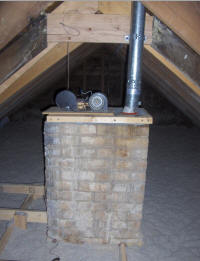
Tim just did a project on EcoRenovators that makes use of attic heat in a nice simple way --he  just blows hot attic air down into the house when the attic is hot and house needs heat -- nice and simple, and it works.

Tims heat from the attic systemThis is Tim's setup -- it uses a chimney that is not in use anymore to channel the air down to the kitchen.  A homemade differential controller decides when to turn the blowers on.
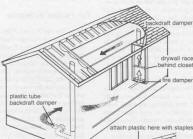


The picture to the left is the "Black Roof" solar heating scheme.  This scheme basically harvests attic heat for space heating with just a few simple components and a blower.  It is said to be effective in cold climates that get quite a bit of sun -- eg Colorado.


There have been a number of schemes to use the attic heat to preheat domestic water.  This is a recently announced commercial offering that uses PEX tubes installed in the attic vent system to harvest heat.


Another idea that I like is picking up the inlet air for the clothes dryer from the attic.  Electric clothes dryers are big time energy users -- they not only use about 4 KWH of electricity per load, but they also end up sucking cold outside air into the house as they blow the air they have just heated out into the cold (wasting all the heat they just added to it).  If you could work out a way to pull hot air from the attic for the dryer it would eliminate all this cold air infiltration and the drywer could use less electricity since its inlet air would be hot already.  The nice thing about this is that you can time the drying to coincide with times when the attic is hot.

The ability to pull useful heat out of the attic will depend a lot on the climate you live in.   In our very cold climate, the space heating applications would be limited to the shoulder seasons, but this still could be an important source of heat.  The link below has my logged hourly attic temperatures for about a year.

If the use of attic heat idea could be incorporated in the initial design of the house there are all sorts of interesting and cost effective things that could be done to make the attic an effective heater.  Things like designing the attic to be a more efficient collector through the design of the roof surface, the attic vent system, and selective use of insulation on non-collecting surfaces could make the attic a fairly efficient and very large solar collector for not a lot of extra expenditure.  Introducing glazing could make the attic collector competitive with commercial air heating collectors.   

Got any ideas on any of this?  Have you used attic heat?  How?


All the details on the schemes above as well as several more interesting ideas are detailed here...

Gary
 
/* Start Analytics ---------------- */ /* End Analytics ---------------- */