Thursday, February 28, 2013

ASES Solar Citizen Program

ASES (American Solar Energy Society) has been been working for more than 50 years to bring about a transition to solar and renewable energy in the US.

ASES has started a new program called the Solar Citizen that is aimed at providing families with the information and tools needed to get their own solar energy projects going.

"We know that most Americans would produce their own clean local energy if it were easy and affordable. We don’t tell you why you should want it. We tell you ­how to get it. We show you who figured it out, and how they did it. We connect you to news and tools to help make it happen on your home, in your town, on your farm, on your church, or on your school."


The latest addition of the Solar Citizen Newsletter "Do-It-Yourself Solar", provides some good information and links for DIY projects and information.

I think its great to see ASES concentrating on helping families get the practical information and tools they need to get solar projects done, and in particular the interest in DIY projects.  Please let them know you think this is a good direction.

Sign up for the Citizen Solar Newsletter....

Also, have a look at these ASES offerings:
ASES would love to have you post your solar or renewable energy projects on their Facebook Page...

Gary

Tuesday, February 26, 2013

A Inexpensive DIY Blower Door That (pretty much) Does It All


This project will tell you how to build a pretty good blower door for about $30. 

You can use this Blower Door to: 
  • Find air infiltration leaks into your house
  •  Trace your progress in sealing the house,
  • Estimate your infiltration flow at 50 Pa (a blower door standard) and compare it to other homes.
  • Estimate your heat loss due to infiltration, and compare it to other heat losses.
  • Estimate fuel saving and CO2 reduction from air sealing your home. 

It basically does what a commercial blower door does, but less automatically and less accurately.  Also makes one helluva ventilation fan.

The furnace blower  blower door  mounted in window with
pressure gage to right.
The blower door is a large fan that is installed in a door (or a window for the DIY one).  The fan forcefully blows air out of the house, which increases the inflow of air through all the cracks in your house that let air in.   This increased flow makes it easier to find the leaks and seal them up.

In addition, the blower door fan can be set up to measure the flow rate out of the house when the pressure difference between the inside and outside of the house is 50 Pa.  This is a standard test that has been done on many homes, so you can see how your house tightness stacks up to other homes.  

In addition, the flow out of the house with a  50Pa house depressurization can be used to estimate the natural infiltration for your house, and this can easily be used to estimate the heat loss, furnace fuel, and CO2 emissions associated with your homes infiltration.

So, basically, a blower door helps you find and seal leaks, tells you how tight your house is compared to others, and lets you figure out the heat loss and furnace fuel that go with the infiltration.   Everyone should have one!

The blower door on its mounting board with the
speed selection switches.

The homemade blower door can do all of these things -- albeit with a bit less accuracy and a bit more work than a "real" blower door.   


The extensive writeup provides all the details on building the blower door, installing it, using it, and all of the infiltration flow calculations so you can calculate the tightness and infiltration heat loss for your house.

The inexpensive 0 to 50 Pa pressure gage for measuring house
depressurization


A real deal commercial blower door.
Gary February 26, 2013

Monday, February 11, 2013

Choosing Insulation -- a talk by Alex Wilson

This is a talk by Alex Wilson on essentially all of the insulation products used in home construction.

The talk covers the environmental effects in depth, and also gets into some of the usability aspects for different applications.

Some of the most common insulating products (eg Extruded Polystyrene) have some very serious greenhouse gas impact and should be avoided where possible.

The talk is hosted on the Building Green site and there is no charge -- I don't know how long the video will be offered.


This is the link to view the video...

Gary


Monday, February 4, 2013

A Prototype Dryer Heat Recovery Heat Exchanger

I did a first cut prototype of a heat exchanger that extracts heat from our clothes dryer exhaust and uses the recovered heat for space heating.  So, this is a brief description of the prototype followed by some questions dealing with how to make it more efficient.

This is just a prototype -- its made out of scrap material I had on hand.  I wanted to investigate what the real heat recovery potential is and to see how bad potential problems such as lint, water, excessive pressure drop might be.

This is a picture of the made from scrap heat exchanger.

It is a stack of 14 twinwall polycarbonate glazing panels that are spaced apart by 1/4 inch.  The dryer air (red and blue arrows above) flows up through the spaces between the twinwall sheets and the room air (green arrows) is drawn in by the fan on top and pushed down through the cells in the twinwall.  This provides about 130 sf of heat exchange area.


The plot above shows a log of heat exchanger inlet and outlet temperatures for the two flows for a good sized load of laundry.

In its current state, it works pretty well.  At the marked location dryer air enters at 136F and exits at 88 F, and the room air enters at 79F and leaves at 95 F.

The recovered heat is equivalent to about 32% of the electricity that the dryer uses to do the load.  There are a few simple changes that might improve this that are discussed at the details link below.  So, not so bad for a first try?

Pressure drop through the exchanger is low and does not affect dryer operation.  Lint is near non-existent so far, and appears to be a very workable problem.

Oddly, very little water or condensation is produced.  The pictures in the details link below show what happens -- basically just a little fog in places and a drop or two.  This is a good news - bad news thing.  Good in that less water will be easier on the exchanger materials, but bad in that the heat used to evaporate the water in the dryer is not being recovered, and this is about half of the heat.


It dawned on me that if the exchanger could be changed so that it condensed out most of the water in the dryer airstream, then 1) you recover the heat that was used to evaporate the water, and 2) you could likely vent electric dryers inside (with a good lint filter).

The number 2 item is a big one in that it prevents the dryer from pulling in outside air that needs to be heated by your furnace.  On cold winter days, this can be about as much energy as the dryer uses in electricity.

By my numbers, a dryer/heat exchanger set up to do the above could save 80% of the total (electric + HVAC) energy used.  This would be a 1000 KWH saving per year for some families.

Homework:
So, if you have a moment, please look over the details link below and see if you can figure out: 1) why the current version condenses out so little water, and 2) what could be changed to condense out a large fraction of the water in the dryer exhaust.

All the details on the dryer heat recovery heat exchanger...


-------------
This is a good paper that covers the incredible amount of energy wasted in clothes drying and gives a good picture of how dryers work and some potential improvements...

Thanks,

Gary


Friday, February 1, 2013

South Wall Solar Space Heating System

This is a really nicely done solar heating project that uses solar water heating collectors integrated with the south wall for space heating.

The solar south wall.
The collector frames are site built and nicely blended into the wall.  The absorber plates were bought from SunRay.

The heat distribution system uses PEX floor loops stapled up to the bottom of the floor.  This is the nice simple manifold for the radiant heat.


The system includes removable reflectors to increase performance.  This kind of reflector is particularly effective in the late spring and early fall when the sun is getting higher and collection is dropping off, but you still need some space heating.


Reflectors have the advantage that they increase solar collection without increasing glazing heat loss.

All the details on Jim's site ...

Recent additions to the system include adding a wood stove  which is interconnected the solar heat storage tank for additional heat.   Jim is also working on a live data reporting system.   A writeup on these will likely be added this summer, so stay tuned.

From Jim -- "I have not turned my furnace on in two years."

Thanks to Jim for taking the time to carefully document the system!

Gary Feb 1, 2013

Sunday, January 20, 2013

Muli-Purpose Low Thermal Mass Sunspaces

I've been working for the past couple months on a new section on Low Thermal Mass Sunspaces.  In the course of doing the testing and putting this material together, I've become a real believer in this kind of sunspace design -- it offers an exceptional combination of space heating performance and multiple use living space that is hard to beat.  I think that if more people came to appreciate how well these low thermal mass sunspaces perform, they would be far more popular.

Low thermal mass sunspaces are very efficient in making a lot of heat that can then be exported to heat the home that the sunspace is attached to.  When designed correctly, they can be just as efficient as high quality active solar collectors for home heating, but in addition to providing space heating, they provide a whole raft of other uses -- including:
  • Space to lounge in the sun (even when it 10F outside).
  • Space to read the paper and have a cup of coffee in the sun.
  • Space for the kids to play.
  • Four season space to dry clothes -- a major energy and carbon saving in itself.
  • Space to dry and store firewood, or have a workshop, or may other uses.
In addition, sunspaces can be very visually appealing and are more likely to pass muster with your HOA or your spouse than are active solar collectors.  I believe that they are also likely to increase the value of your house more than other energy saving investments due to their aesthetic appeal and mulit-purpose nature.

These sunspaces are efficient space heaters because their design is optimized to generate a lot of heat and to get that heat to the house.  They intentionally have very little thermal mass -- this makes them heat up very quickly, and the heat they generate is transferred to the house rather than being used to heat thermal mass in the sunspace. 

I don't know of any other solar investment that is so cost effective as an energy and carbon saver, and at the same time provides so many other family benefits.
Included in the new section:
- A design guide that explains what the low thermal mass sunspace is, how it works, and why its efficient.  The guide also covers a number of design guidelines that you want to follow to make a sunspace that is both an efficient heater and a pleasant place to spend time.   

- Some careful tests done on my sunspace to measure the actual heat output and efficiency for an optimized sunspace and compares it to high quality active solar collectors.  The bottom line is that a well designed low thermal mass sunspace is just as efficient as a space heater as high quality active solar collectors -- and you can enjoy a nice morning cup of coffee in the sun sitting inside your collector!

Another result that emerges from this testing is that there are several design rules that need to be followed if the sunspace is to be an efficient producer of heat.  
- Several good and detailed descriptions of low thermal mass sunspaces that cover the whole wide range of possible designs.   Here are some examples of the examples:

This is Mike's retrofitted low thermal mass sunspace in the Colorado mountains.  It is an efficient space heater for the house, but also provides a wide range of other uses including lounging in the sun, kids play area, and a clothes drying area that saves an additional 1200 KWH a year in itself -- just this side benefit is equivalent to the yearly output of a 1000 watt PV array. And, it looks great.


This is Nick Pine's new cutting edge three story low thermal mass sunspace.  Nick has tried a number of innovations in this sunspace including DIY clear polycarbonate glazing, a unique air distribution system, and a mesh scheme that promises even more efficient operation.


This is Architect William Sikora's modern and elegant low thermal mass sunspace in Minnesota.  The sunspace not only looks great, but it is designed to be very simple in operation and maintainable by the home owner using only ordinary tools.


There are other examples that show how very low budget versions of the sunspaces can be built that are still effective heaters, and an example of a 100% solar heated home that uses a low thermal mass sunspace as the only heat source.

The main index for the new Low Thermal Mass Sunspace section ....

I want to particularly thank Mike P., Nick Pine, and William Sikora for taking the time to document their sunspaces.

For all you low thermal mass sunspace owners out there, I hope you will use the comments section (or email me) to pass on your experiences with your sunspaces.

Gary


Friday, January 4, 2013

A DESIGN CHALLENGE for pop can and downspout collector builders


Solar air heating collectors that use columns of aluminum soda pop cans or that use metal gutter downspouts as the absorber are quite popular. 
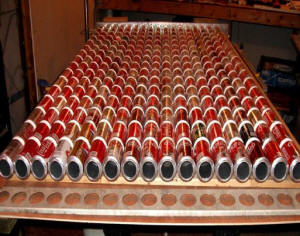
pop can collector
Greg's pop can collector in work
In this design, the supply air flows into a plenum at one end and is distributed to the pop can columns or downspouts, the air then flows up the pop cans.  The sun striking the outside of the black painted cans heats them up, and this heat is transferred to the air flowing up through the cans. 

One of the challenges for an efficient design is to get the same flow in each of the pop can columns.   Having unequal flows in the columns makes for a less efficient collector with some parts of the collector running hotter than they need to and losing heat out the collector glazing.
When I built a downspout collector for testing against other collector types, I was unable to come up with a plenum design that gave an even flow in the downspouts...  I think that this may have been a significant part of why the collector did not do so well in the testing compared to the screen absorber.

Sooooo, if you are building or have a pop can or downspout collector, how about testing the flow in each column, and see how the flow comes out on yours.  If its not close to the same in each column, maybe you can experiment around with changes to the collector to get the flow to even out? 

Testing for even flow is easy to do, and coming up with a collector/plenum design that provides even flow to all the can columns would be a real benefit to a lot of collector builders. 

On my prototype, I measured the flow by making a small hole in each column, and then read the column air velocity by inserting a wind meter in the hole.


The results looked like this...

Flow in each of the 13 columns.

Gary
January 4, 2013


Monday, December 17, 2012

A Unique and Cost Effective Solar Space Heating System

Taylor's space heating system has a couple of unique features that I like and think are worth taking a look at if you are planning a solar space heating system.

He describes the system on his blog here...

One of the unique features is the use of inexpensive pool heating collectors.  He adds polycarbonate glazing to the collectors to get the performance up in the same area as commercial glazed space heating collectors.  The danger here is that if the collectors are stagnated (no flow), the temperatures inside the collector can get high enough to damage the the polypropylene pool heating collector.  To avoid this he fits the glazing with some air leakage paths to bring the stagnation temperatures down.

The glazed pool heating collector.
This is the same idea that I have been looking into on our new inexpensive, off-the-shelf solar water heating system.   I think this idea has a lot of promise for getting solar water and space heating costs down.  But, bear in mind that its still on the experimental side.

The other feature I like in the system is that Taylor uses a commercial off the shelf water to air heat exchanger to distribute the solar heat to the house.

The water to air heat exchanger -- has to be one of the funkiest looking ones ever!
Even with the relatively low temperature hot water that solar heating systems typically provide, these heat exchangers will deliver quite a bit of heat.  On Taylor's system, the airflow through the heat exchanger is driven by a fan that is PV powered.

One thing to bear in mind about heat distribution for solar heating systems is that unless you have an exceptionally well insulated house, or a very large solar collector array, the solar heat will be a supplement that reduces your heating bill, not your only source of heat.  This being the case, the thing you want the heat distribution system to accomplish is to be able to always deliver the solar heat you collect during a day to the house during that day and through the night.  Its not important that the solar heat distribution system be able to supply the whole heat loss of your house on a cold day -- you have a furnace for that.  What's important is that all of the solar heat that you collect gets delivered to the house overnight.  This can make a world of difference in the size of the distribution system needed.

For a ton of other solar space heating systems and ideas go here...


Gary
December 17, 2012

Saturday, December 8, 2012

DIY Heat Recovery Ventilator (HRV)

An HRV pulls fresh air into the house and exhausts stale air to the outside.  In the HRV, the fresh and stale air pass through a heat exchanger that recovers most of the heat remaining in the stale air to heat the incoming fresh outside air -- thus providing a significant saving in energy to heat the incoming air.

While I've been looking for material on building an HRV, I've not had much luck in finding anything that appeared to have a chance of working well over time.  This book from William Shurcliff that has a little on a DIY design, but its pretty minimal.

Paul from BC noted the above page and came through with the article below describing an HRV design that uses sheets of Coroplast material for the heat exchanger.  Paul actually built one of these for his own house some time back and it worked well for the time period he was in that house.  It seems to me that the Coroplast has a descent chance of holding up well in the somewhat hostile (wet and even icy) environment inside an HRV heat exchanger.  Thank you Paul for sending this in!

The Coroplast HRV design


Full details on building the Coroplast sheet HRV...

New section on HRV's ...
A completed HRV

Gary
December 8, 2012


Monday, November 19, 2012

Solar Greenhouse Research -- No Heat Needed

Here are three solar greenhouse projects just added to the site.  One in Missouri, another in Manitoba, and our new solar greenhouse in Bozeman.

Solar Greenhouses are roughly defined as greenhouses that can grow things through the winter without supplementary heat -- that is, they are 100% solar heated.

A University of Missouri Solar Greenhouse with 18 Year Track Record

This is a greenhouse I ran across while looking for a good design for our own solar greenhouse project.  It was designed and built by the Univ of Missouri extension about 18 years ago, and has been used for researching winter greenhouse growing since then.  
Its designed to work well through the winter with the steeply tilted, double wall glazing, the north roof sloped to reflect light on the growing area, all surfaces insulated except the south glazing, and thermal mass in the form of water barrels.

It successfully grows through the winter with no supplemental heating.

We liked it enough to model our solar greenhouse (see below) generally after it.


Solar Greenhouse Research in Manitoba

These are some articles and a paper on a solar greenhouse research project in Manitoba.  Part of the project involved taking a wide greenhouse and subdividing it into 4 separate, side by side spaces.  Each space was used to test a different glazing or insulating scheme through the winter.


Solar Experimenation "Thing" in Montana

This is our new solar greenhouse project here in Bozeman.  It is actually a scaled down version of the U of M greenhouse above.  

While its intended to be our greenhouse for the long run, we plan to first use it to do some testing of the performance of low thermal mass sunspaces attached to a house and used for space heating of the house, and then for testing the idea that it possible to build a small (tiny) room in one end of the GH that will be able to maintain a comfortable temperature through the winter on just solar.  This is a tall order in our climate, but we will see what can be done later this winter.

The GH with its 60 deg tilt, south facing glazing -- all other surfaces are insulated.

Building the frame

Temperatures in the first three days after being closed in.
30F outside -- 120F inside.

Any ideas or suggestions on this project would be appreciated.


Gary

 
/* Start Analytics ---------------- */ /* End Analytics ---------------- */